
The BFCM List: 10 Last-Minute Moves from Top Operators on The Starters

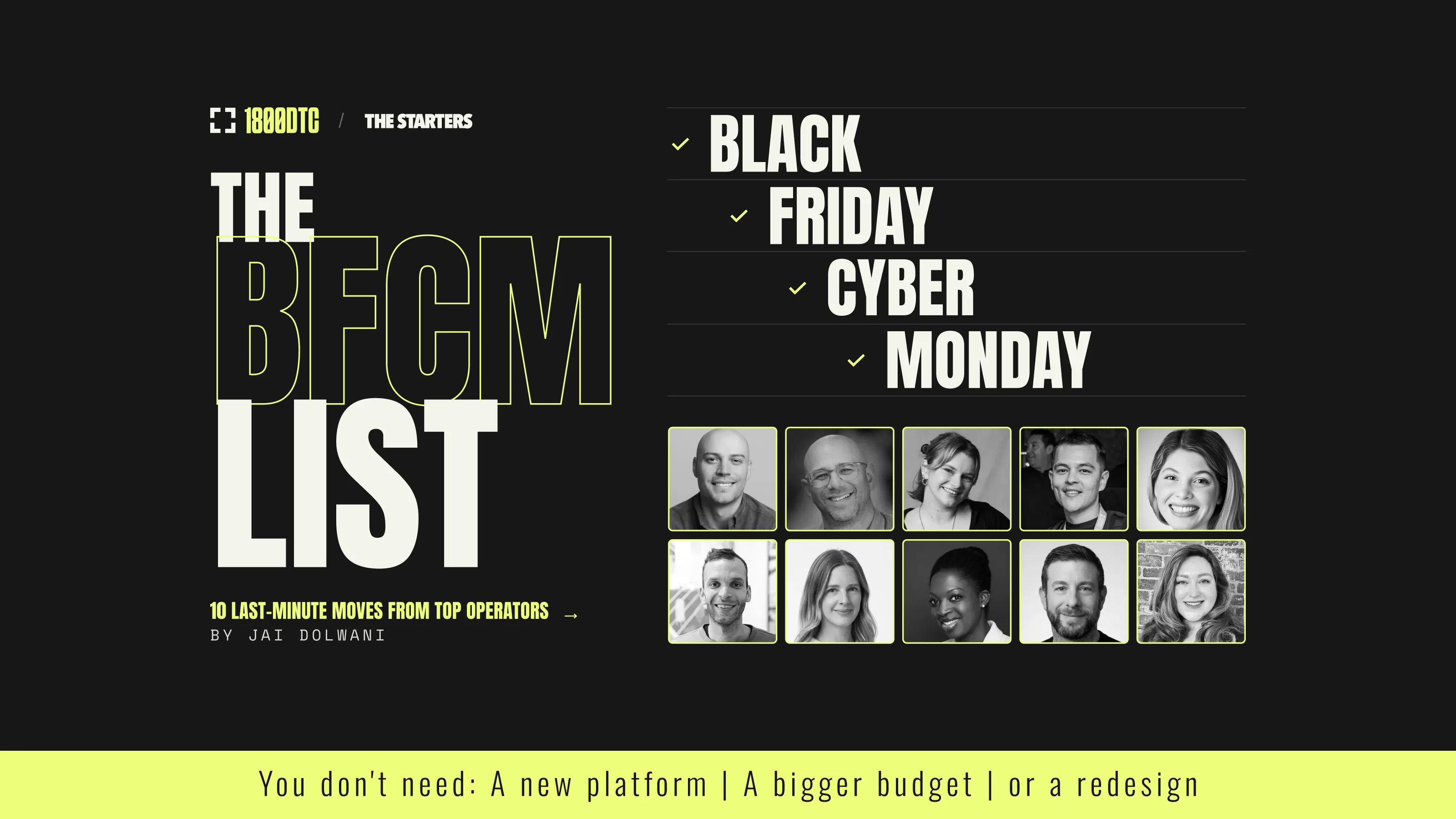

This article was originally published on 1800DTC.com
Key Takeaways
- With BFCM close, focus on what a customer sees from ad to checkout, who you sell to first, and how you frame the offer.
- Your fastest levers are the ones you already have: your best customers, your existing Black Friday page and your top-performing ads.
- Pick one or two of these moves and do them well. Two weeks is enough for a couple of focused changes and not enough for ten.
Getting Ready for BFCM
Most brands have locked their BFCM offers, creative and inventory. That is how it should be. The last two weeks before the biggest sales period of the year are a bad time to invent a new strategy, and a good time to find the small, specific changes that protect your margin and help the traffic you are about to pay for convert.
We asked operators in The Starters, a network of e-commerce experts who work with consumer brands, one question: what is the single top last-minute BFCM move a brand can still make?
The answers cover creative, lifecycle, the customer journey, offers, search and marketplaces. Each is something a small team can start this week.
1. Run Your Own BFCM Customer Journey

From Temilola Agbede, who helps DTC-first brands build marketing strategies that go beyond Meta. Her roles include VP of eCommerce at Dropps and VP of Digital & eCommerce at Love Wellness. See Temilola's Starter profile.
Temilola's advice costs nothing but an hour. Before the promotion starts, use your mock-ups or a staging site and follow a representative Black Friday ad or email the way a customer would. Start with the landing page and read it twice: first like a stranger, then like someone who knows your brand. Then go through add-to-cart and checkout.
Wherever you hesitate or end up with a question, that is your first area to fix. The usual causes are an unclear offer, important content below the fold, and buried shipping timelines. None need a redesign. Two weeks is enough to fix the top one or two, and a customer who understands your offer and delivery date is far more likely to finish checkout.
2. Get Your Best Customers to Buy Before BFCM

From Jon Levine, a marketing executive with 20+ years across start-up, scaling and enterprise brands. His marketing leadership work includes Hedley & Bennett and Roam Luggage. See Jon's Starter profile.
Too many brands start BFCM weeks early with the same offer, or keep changing promotions and confuse customers. Jon's alternative, especially with a strong repeat customer base, is an early window. Segment your highest-value and repeat buyers. A week or two ahead of BFCM, send them a compelling offer positioned as exclusive access instead of another discount. These customers already know your brand, so you do not need to spend heavily to win them again.
That brings purchases forward at a lower acquisition cost, so the main BFCM window can focus on new customers. Jon used this with a high-consideration gifting brand with a large base of past buyers, rebuilding the lifecycle strategy around segmented repeat-buyer offers timed ahead of broader promotions. He says it improved repeat purchase performance and reduced reliance on paid acquisition. His bottom line: do not spend your most expensive acquisition dollars on customers who already know and love your brand.
3. Write the Ad for the Person Buying for Themselves

From Collins Elizabeth, who writes and produces DTC ads for consumer health brands. She was the first Creative Strategist at O Positiv. See Collins's Starter profile.
Not every product is a gift. Supplements and practical items are usually not things people buy for others, Collins notes, and if that describes your product, a standard gifting angle can work against you. Her advice: know your market, switch the angle to "treat yourself," and focus on the holiday stress your customer is feeling.
She gives an example from O Positiv. The team knew people were not likely to buy vaginal probiotics for their friends and family, so they leaned in and ran ads with the headline "no one is going to buy this for you." They emphasized that some gifts are meant to be given to yourself this season. Collins says that ad was a top spender for the whole BFCM season.
Ask who actually buys your product, and for whom. If the honest answer is "mostly for themselves," your BFCM creative should talk to that person. It is a messaging change you can test in your next ad variations without touching your offer, site or budget.
4. Keep a Long Sale Fresh With Daily Deals

From Meg Marsh, who scales DTC operations by fixing what slows brands down. Her experience includes Parachute and The Honest Company. See Meg's Starter profile.
If your sale runs for weeks, the middle gets quiet. Meg's answer: add daily deals, giveaways or raffles on top of the main offer. They give people a reason to come back and buy more than once. A big deal on one product for one day gets noticed in a sea of site-wide discounts, and because it lasts one day, it protects margin. Play up the urgency on each so people buy before it is gone, then come back for tomorrow's surprise.
5. Lead With the Reason to Believe, Then Get Out of the Way

From Katharine McKee, an Amazon and ecommerce strategy consultant for consumer brands. Her experience includes Amazon marketing for Coty, Luxottica and Stila. See Katharine's Starter profile.
Katharine's rule for the final stretch is that persuasion beats promotion. Before marking products down further, get crystal clear in email and ad copy about why your product is the best choice. Consumers buy good before they buy cheap, so a sharper reason to believe protects margin better than a deeper discount.
Then get out of the way. People shopping your site in this window are stressed and moving fast, so this is not the time for founder videos, popups and quizzes. Make the path to purchase, and the reason to believe, the main focus.
6. Reuse What Already Works

From Carlos Sanchez, a performance creative lead. He led growth and creative at Sweetflexx and worked on Dr. Squatch and Native at Raindrop Agency. See Carlos's Starter profile.
Carlos's quick wins start from assets you already have. Add a BFCM banner to your top performing email flows, especially browse, cart and checkout abandonment, and a banner under the add-to-cart button on product pages linking to your BFCM landing page. Instead of building new ads, add sale blurbs and stamps to your best performing ads from the last three months. During the sale, follow up with BFCM customers on cross-sells and give them a reason to buy again.
7. Mine Your Three-Star Reviews

From Amanda Hitchcock, a brand, UX and ecommerce design lead. Her design work includes Julie Vos and Tiami Sleep. See Amanda's Starter profile.
Amanda's suggestion is to read your three-star reviews. The people who almost loved the product have told you what they needed to know before buying: "Smaller than I expected." "I wish I had bought the larger one." Put those answers where the next customer can find them: show the scale, explain the upkeep, make obvious what comes in the box.
8. Update the Black Friday Page You Already Have

From Kev Wiles, a fractional SEO director for Shopify and DTC brands. His experience includes Gruns and Halfords. See Kev's Starter profile.
Kev's view: two weeks can still be enough to move seasonal rankings with pages Google already trusts. Update your existing, indexed Black Friday URL rather than launch a new one: add a dated, answer-first section with the offer, dates, exclusions and returns, and link to it from your highest-authority pages. AI answers draw on the same results, so Kev also runs 20 to 30 BFCM prompts through AI Overviews, ChatGPT and Perplexity, notes which pages get cited, and pitches the most-cited roundups and gift guides with an exact offer and exclusive code while editors are compiling them.
9. Get Your Product Data Ready for AI Shoppers

From Taylor Page, a Shopify technical partner who helps brands decide what to build, buy or hand to AI. His Shopify Plus clients include Hello Adorn and Bella Belle Shoes. See Taylor's Starter profile.
This could be the first BFCM where shoppers ask AI assistants what to buy. Kev's move gets your Black Friday page cited in those answers; Taylor's is about the product data the assistants read when recommending products. The tools are already in your Shopify admin, and the work is data, not storefront changes, so it fits around a code freeze. Start with your top holiday sellers: confirm each has the most specific product category, then fill in the attributes Shopify suggests for it, like color, material and size. Next, review your Knowledge Base, which Shopify has likely drafted from a scan of your storefront. Add your holiday shipping cutoffs and return window and publish: this is what AI agents use to answer questions about your store.
His two-minute starting point: open the Agentic sales channel in your Shopify admin. Orders that arrive through AI channels such as ChatGPT appear there with attribution, which tells you how much the rest of this work matters for your store.
10. On Amazon, Go Big or Go Home

From Fernando Torres, who launches and scales brands on Amazon. His Amazon roles include interim manager at Autobrush and marketer at Freebird. See Fernando's Starter profile.
Fernando's rule for Amazon: give your best discount of the year or do not discount at all. Fernando recommends a discount of at least 20% rather than giving away margin on an offer shoppers may overlook. Check Amazon's current eligibility rules for your deal type before setting the promotion. Low on stock? Send inventory now: even if it misses check-in for Black Friday, it will process in the days after, when you need it most. Create a Fulfilled by Merchant SKU as a backup in case you stock out.
Conclusion
None of these moves needs a new platform, a bigger budget or a redesign. They change how you spend, who you reach first, what the customer sees and how you describe the offer. In the last two weeks before BFCM, small and specific beats big and new.
If you want help from operators like these, you can find them at The Starters.
Frequently asked questions
I only have time for one change. Which should I make?
Match it to your weakest area. Temilola's walkthrough finds site friction, Collins's self-gifting angle rethinks the ad, Jon's early window works with a repeat buyer base, and Carlos's banners ship fastest.
My sale runs for several weeks. How do I keep it from going quiet?
Meg's answer is daily deals, giveaways or raffles layered on the main offer. A one-day deal on one product gets noticed, protects margin, and gives customers a reason to come back.
How do I use BFCM to find new customers if my best customers buy first?
That is Jon's point. If your highest-value and repeat buyers purchase in an early window, the main BFCM period is free to focus on acquisition, so more of your ad budget works on shoppers who do not know you yet.
Get the best in intelligence to your inbox.
- Operator insights on the tactics and systems driving modern e-commerce growth.
- Clear analysis of the shifts shaping modern e-commerce.
- Unfiltered conversations with the people actually building great brands.
Your submission has been received!
Create a free account to continue reading
Get access to intelligence from e-commerce's top operators with a free Starters account.
Continue reading with a Starters subscription
Get unlimited access to The Starters’ exclusive reporting and ad-free intelligence. Membership is $295/month, or $195/month billed annually at $2,340/year.