
Smaller Teams, Bigger Output: Building Teams in the AI Era



A Note Before We Begin
On November 11th, 2021, I stood on the floor of the New York Stock Exchange, celebrating the IPO of Winc, the direct-to-consumer wine club I had just helped take public.
In the 18 months prior to our IPO, I had been promoted 4 times from Retention Lead to Chief Marketing Officer and built my team from 2 to 40+ full time, onshore staff.
Needless to say, I was on top of the world.
But things quickly changed.
In the 3 months following our IPO, our stock declined 97%, our primary line of credit was pulled, and we were wildly unprofitable with no ability to raise additional capital.
Out of options, I laid off the team I had just hired, one by one.
People who had moved across the country to work with us. People who left stable, well-paying jobs to take a bet on me. And most importantly, people who had grown to be my closest friends.
It was the most difficult time of my professional career. I had failed so many people.
But not even aggressive layoffs were enough. Less than 12 months after our IPO, Winc declared bankruptcy.
When it fell apart, I did what most people do: I went looking for a lesson.
I expected to find one about fundraising, or unit economics, or market timing. And yes, all of those things were large contributors to our downfall… but none entirely in my control.
What was in my control, and where I went wrong, was building a team that was unsustainable.
Not the wrong people. Many of them were brilliant. But I had built a pyramid: layers of management and armies of executors and specialists on full-time payroll.
I did what I thought I had to do. The things they teach you in business school or management books. But I was naive, and what I had built was wrong. Our team was bloated, slow, and very, very expensive.
I launched The Starters in January 2023 because I learned from that lesson and believed there was a better way to build sustainable teams: embracing the power of fractional talent.
Since then, we've helped more than 1,000 e-commerce brands hire the best freelancers in the world. What I've watched play out across those engagements has only sharpened the conviction I walked away from Winc with.
Now, in 2026, we are in the middle of one of the most significant shifts in how companies are built that any of us will see in our professional lifetimes.
AI has made execution cheap. Dramatically, almost uncomfortably, cheap.
A three-month brand refresh is now three weeks. A copywriter who produced ten pieces of content a month can produce five hundred. Strategic decisions that used to take weeks of analysis can be made in hours.
This should be a massive unlock.
But what's played out in reality is quite the opposite.
Some brands are racing to replace their entire team with AI… freezing hiring, laying people off, treating headcount reduction as the strategy.
And on the other end, some brands are paralyzed by the noise, ignoring AI entirely, running the same team and the same playbook and hoping the moment passes.
Neither works. I've seen both up close.
What I know is that the brands winning right now aren't the ones who went the leanest or the ones who changed nothing. They're the ones who got intentional. They figured out what AI should own and what humans must own, and they built accordingly. They held onto the humans with the judgment, the taste, the operator instinct that no machine can manufacture. And they let AI handle everything else.
This article is my attempt to show you what that looks like in practice.
The New Paradigm
Let's be honest about what has actually changed, because the instinct is to either overstate it or understate it, and both are dangerous.
AI has not replaced human creativity. It has not replaced judgment, taste, or strategic thinking. What it has done is fundamentally alter the economics of execution, and that changes everything downstream.
Consider four specific shifts that are already real for most DTC brands operating today:
Time-to-delivery has collapsed. Work that used to take months now takes weeks. Work that used to take weeks now takes days. The constraint is no longer production capacity, its decision-making speed and quality of direction.
Entry-level output is now effectively free. Tasks that used to justify junior hires—first drafts, basic research, competitive analysis, data formatting, image resizing—are now a well-crafted prompt away. The bar for what justifies a full-time entry-level hire has risen significantly.
Execution volume has multiplied. A single skilled operator, equipped with the right tools, can now produce what used to require a large team. The ceiling on individual output has risen so dramatically that the old staffing models, built around how much one person could do, are simply no longer accurate.
Decision velocity has increased. Analysis that used to take weeks can now be done in hours. This is genuinely powerful, but it creates a new risk: the speed of analysis can outpace the quality of judgment applied to it. More data, faster, is only an advantage if someone knows what to do with it.
The net effect of all four is this: the value of execution has compressed, and the value of judgment has expanded.
What's Shrinking, What's Shifting, What's Gone
I want to be careful here, because this is the part of the conversation that generates the most anxiety (and the most bad decisions).
Some roles are genuinely shrinking. Execution-heavy creative positions, media buyers managing primarily algorithmic channels, large engineering and development teams doing work that AI can now handle in a fraction of the time… all of these require fewer people to do the same amount of work. That is simply true, and pretending otherwise doesn't help anyone.
Some roles are not disappearing, but evolving. The marketer who used to spend 80% of their time producing content can now spend 80% of their time on taste, judgment, and strategy to produce more and better content than they ever did before. The senior creative who used to be a producer is now a brand steward, the final filter on everything that ships. These people don't go away. Their jobs just change.
And some roles are effectively gone. Coordinators whose primary value was moving information between people. Data entry and reporting roles that existed to compile and summarize. Basic, templated customer service interactions. These are never coming back in their old form.
Here's where most brands go wrong: they see the shrinkage and the disappearance, and they cut broadly. They treat headcount reduction as the strategy. And for a while, maybe a long while, they feel smart for it. Leaner, faster, more efficient. Then, quietly, they start losing. Their content starts sounding like everyone else's. Their campaigns miss. Their strategy drifts. Their brand starts to feel hollow, because the people who knew what "good" looked like are gone, and what's left is a team that can produce a lot of something that isn't quite right.
The brands that win aren't the leanest. They're the ones that cut the right things and invested in the right things.
Which brings us to what those right things are.
The Roles That Become Irreplaceable
There is a layer of talent that AI cannot replicate.
Not because the technology isn't powerful, but because what this layer does cannot be distilled into a prompt, a workflow, or a model.
I call it the taste layer, and it shows up in three archetypes.
The Editor knows what good looks like before AI generates a draft. They're the person who can read something in the first paragraph and know whether it sounds like the brand or just sounds like content. They catch what AI gets wrong… the subtle drift in voice, the slightly-off claim, the creative direction that technically answers the brief but misses the point entirely. In a world where AI can produce infinite volume, the Editor is the quality ceiling. Without them, you produce a lot. With them, you produce something worth producing.
The Strategist decides what to build and which direction to move. They understand the market, the moment, and the customer, not just the data about those things, but the meaning underneath the data. They ask the questions that AI doesn't know to ask. They set the direction that everyone else, including AI, executes against. As decision velocity increases, the Strategist becomes more valuable, not less, because the speed of analysis now dramatically outpaces most teams' ability to apply good judgment to what they find.
The Operator brings elite pattern recognition that only comes from years of real experience. They've seen what moves a business and what doesn't. They know which levers matter and which ones look good in a deck but don't actually change outcomes. In a world of infinite execution capacity, the Operator creates focus, the most underrated competitive advantage in DTC right now.
These three roles are not job titles. They're capabilities. And the best operators in every function, the best CMOs, the best heads of growth, the best creative directors, the best CFOs, embody all three in different proportions.
Chad Janis built Grüns from launch to a $1.2 billion acquisition by Unilever in under three years. When asked what mattered most in building the company, his answer was simple:
"You have to surround yourself with the absolute best."
The best operators now are the ones who bring irreplaceable judgment and know how to use AI to multiply their impact. That combination is genuinely rare, and it's becoming the most valuable thing a brand can access.
Hire Differently
If the value of talent has shifted, the way you evaluate talent has to shift with it.
The old hiring question was: can they do the work?
We hired for executional excellence. Hard skill sets, production capacity, the ability to generate volume. The more someone could do, the more valuable they were.
The new hiring question is: do they have good judgment?
Execution is now a commodity. Anyone with the right tools and enough time can produce. The only thing that separates a great hire from a mediocre one is the quality of their decisions.
There are three things worth screening for in every hire you make right now:
Judgment is a strong point of view and the ability to recognize quality without being told what it is. Ask someone to critique a piece of work. Your brand's work, a competitor's, something you found. Watch how they think. Watch whether they have something to say. Judgment is hard to fake in an interview, which is one of the things that makes it such a useful signal.
Instinct is gut feel around what resonates with your customer, your partners, your market. It's harder to articulate than judgment but just as important. The people with great instinct are the ones who called the right creative direction before the data confirmed it, who knew the channel was shifting before the numbers showed it. You find them by looking at their track record of calls, not just their credentials.
Tool fluency is the ability to use AI well, and, critically, to know where it falls short. This is different from simply being comfortable with technology. The most dangerous hire in 2025 is someone who outsources all of their thinking to AI: no original perspective, no quality filter, just a steady stream of generated content with a human's name attached to it. You want people who use AI to amplify their judgment, not to replace it.
The same people who were great before—great operators, great creative directors, great strategists— AI makes them superhuman. They now have execution capacity that used to require an entire team, and they still bring the one thing the team couldn't manufacture: the judgment and instinct to use it well.
The Org Structure Has to Change Too
This isn't just a hiring conversation. If you change who you hire without changing how you organize, you'll underutilize the talent you bring in and overbuild in places that don't need it.
The traditional pyramid—C-suite at the top, VPs and directors below, managers below them, individual contributors at the base—was designed for a world where execution required headcount at every layer. The more people who could produce, the more the company could do. Span of control mattered because coordination was expensive and human.
Thinking through your organization through that model is now a liability.
The org structure that works in the AI era looks different.
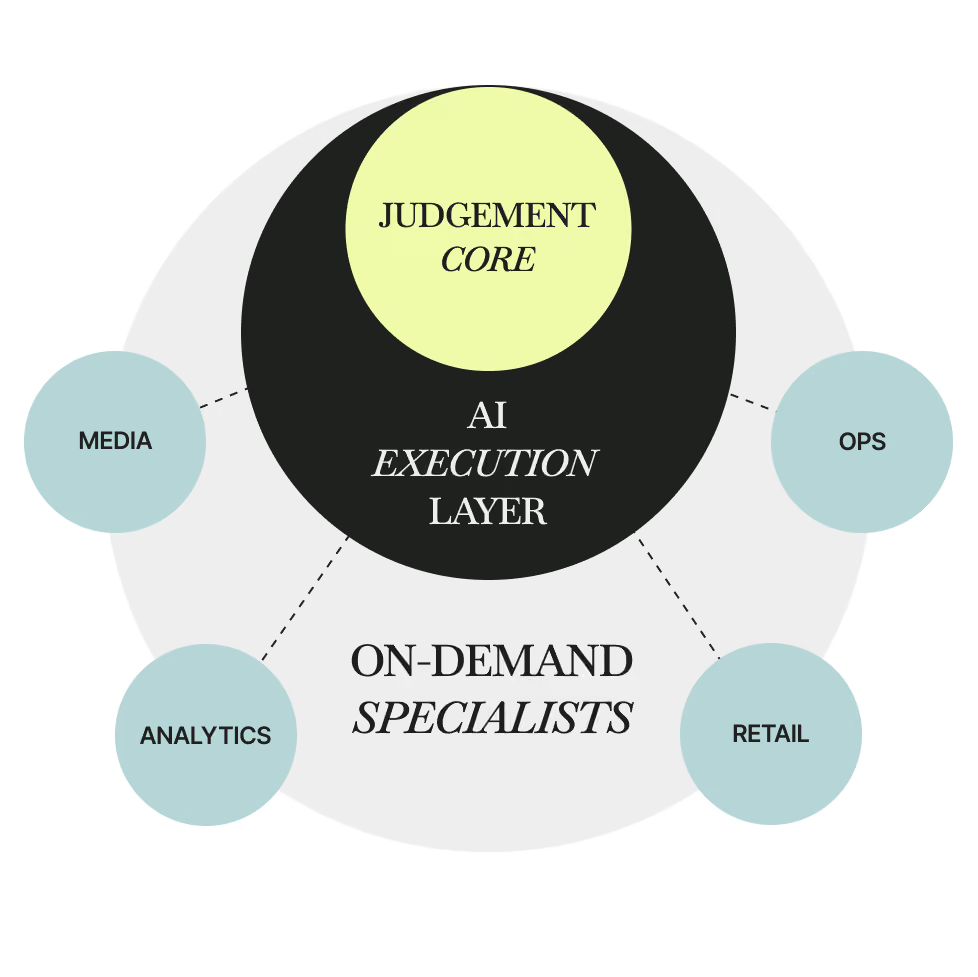
At the center is a small, senior Judgment Core. The people who set direction, make the calls that can't be automated, and catch the mistakes before they ship.
Around them is an Execution Layer that handles the volume: content, analysis, reporting, research, first drafts, data synthesis. This layer is heavily driven by AI tooling.
And surrounding both is access to On-Demand Specialists: deep expertise in specific functions, brought in when a problem actually requires it, not carried on payroll when it doesn't.
This is what fractional talent was always supposed to be. Not just a workaround for companies that can't afford full-time hires, but the optimal architecture for companies that understand where value actually lives. A $20,000/month head of growth who's on-site five days a week is not necessarily more valuable than a $8,000/month fractional operator who's seen thirty brands like yours and knows exactly what to do.
The brands running this model are doing more with a fraction of the headcount they'd have carried three years ago, and producing better work. Not because they're doing more with less, but because they're doing the right things with the right people.
How to Start
The shift described in this article isn't a future state. It's happening right now, inside your competitive set, and the gap between brands that adapt and brands that don't is widening every quarter.
How can you catch up? Here’s a practical starting point, broken into three steps:
Step 1: Audit your team. Go role by role. For each person, ask honestly: are they primarily bringing judgment to the table, or execution? If execution, identify the tooling that could 10x their output, and evaluate whether the role needs to exist in its current form or at its current size. This is where you eliminate roles and shrink teams of executors from 5 to 1.
Step 2: Find your judgment gaps. Look at the decisions your team has made well over the last twelve months… and the ones that went poorly. The poor decisions are diagnostic. They reveal where senior expertise is missing, where pattern recognition isn't present, where someone needed to know what good looked like and didn't have enough reference points to find it. Those gaps are the highest-value things to fill
Step 3: Reallocate OPEX. Go function by function and channel by channel. Where do you have specialists as full-time employees doing work that appears in bursts? Evaluate moving to fractional. Where do you lack specialist depth entirely? Bring in someone on-demand for the problem at hand. Do you need to solidify your “Judgement Core” to make better decisions? Do that. The goal isn't to cut the budget, it's to redirect it toward the highest-leverage version of every dollar spent on talent.
None of this happens overnight. But the first step… the audit, the honest assessment of where judgment lives in your org and where it doesn't… can happen today.
The Uncatchable Brands
Imagine it's the end of this year.
Some brands looked at the AI moment and got lean. They cut headcount, reduced OPEX, ran smaller teams, and bought themselves a quarter or two of better margins. That was smart.
Some brands looked at the same moment and got lean and got smart. They rebuilt around judgment. They brought in senior operators who knew what good looked like. They let AI handle the volume and let humans handle the thinking. They moved faster, not just cheaper.
The first group will feel good for a while.
Then, all of a sudden, they won't.
The brands that understand what's actually scarce right now… not execution, not content, not analysis, but genuine human judgment applied to all of the above… and build around that scarcity will be operating at a level that's genuinely hard to close the gap on.
Their output will be better. Their decisions will be better. Their brands will feel more alive.
That's what The Starters is built for. Not to help brands find more people, but to help them find the right people: senior operators with real track records, available in the engagement model that fits the problem, at a quality level that moves the business.
Human brilliance is your ultimate advantage. Build around it.
Get the best in intelligence to your inbox.
- Operator insights on the tactics and systems driving modern e-commerce growth.
- Clear analysis of the shifts shaping modern e-commerce.
- Unfiltered conversations with the people actually building great brands.
Your submission has been received!
Create a free account to continue reading
Get access to intelligence from e-commerce's top operators with a free Starters account.
Continue reading with a Starters subscription
Get unlimited access to The Starters` exclusive reporting and ad-free intelligence for just $249/month